Closest listed airflowWall / shutter exhaust
Airflow sizing tool
Fan CFM calculator
Size your airflow. Find your fan. Enter your room and ventilation target for a tailored shortlist, or choose “Circulate air” to compare cooling fans.
Airflow at 6 ACH
See result details ↓396CFM
See result details ↓396CFM
01
Tell us about your space
3,960 ft³ of room volume
Try a space
02
Set your ventilation target
6 ACH is an editable assumption. It is not a recommendation for this room.
Not sure which ACH to use?
Use your project’s ventilation requirement if known. The buttons let you explore lower and higher flow; they are not room-type standards. Occupancy, heat, moisture and processes change the requirement. Room volume alone cannot determine it. How to choose a target →
Updates as you type
Your ventilation target
396CFM
of delivered outdoor airflow to reach 6 air changes per hour.
Find fans for my targetAlso expressed as672.8 m³/h
One nominal air change10 min
Formula & official sources
3,960 ft³ × 6 ACH ÷ 60 = 396 CFM
The main result rounds up to the next whole unit. Calculations use unrounded values.
Ventilation method: CDC’s ACH equation · Greenheck’s fan-sizing method. Room size × ACH calculates ventilation flow, not a ceiling or floor fan’s cooling performance.
Select equipment using airflow at your system’s pressure. Ducts, grilles and shutters can reduce delivered flow.
What if you change the target?Same room. Different assumptions.
Room simulator
Watch your room cool down.
Drag fans, windows and doors anywhere. Drag the walls or draw your own floor plan. The simulation updates live.
Add
440 ft² · 9.0 ft ceiling
Elapsed time10 min
03060 min
How the simulator works, and what it can’t tell you
Airflow. The room is a top-down grid of a few thousand cells. Each frame the model solves incompressible, depth-averaged airflow: wall fans push or pull their rated airflow through the wall, open windows and doors sit at outdoor pressure, and floor fans add a jet as wide as the fan. Floor and ceiling friction slow the air. Air speeds are relative; the model does not give velocities you can measure at a workbench.
Temperature and fresh air. From the averaged flow the model solves the steady local mean age of air, a standard ventilation measure of how long air at each point has been inside the room. Turbulent mixing uses an eddy diffusivity based on local air speed plus a background for everyday convection. Each point then cools on its own time scale. Heat gain uses the sensible-heat relation, BTU/h = 1.08 × CFM × ΔT. The mixing score divides the nominal air-change time (volume ÷ airflow) by the room’s mean age: about 1 means well mixed, above 1 is a sweeping flow, below 1 means short-circuiting.
Limits. This is an educational model, not an engineering CFD study. It ignores wind, stack effect, sun on specific walls, furniture, vertical layers of hot air, duct and shutter losses, and humidity. A fan’s rated airflow is not its installed airflow. Ceiling fans add mixing and an illustrative spread under the fan; they don’t change the outdoor-air rate. For contaminants, fumes or code-required ventilation, use a qualified designer.
03 · Choose your equipment
Fans for your airflow target
Start with the closest listed airflow, then check the installation details.
Required delivered flow per fan396 CFMat the installed pressure
These are catalog matches. Listed airflow can fall after adding shutters, ducts or grilles. Before buying, confirm each fan delivers 396 CFM at your installation’s pressure. How we match fans
3 options · closest ratings at or above your requirement
Compare these fans →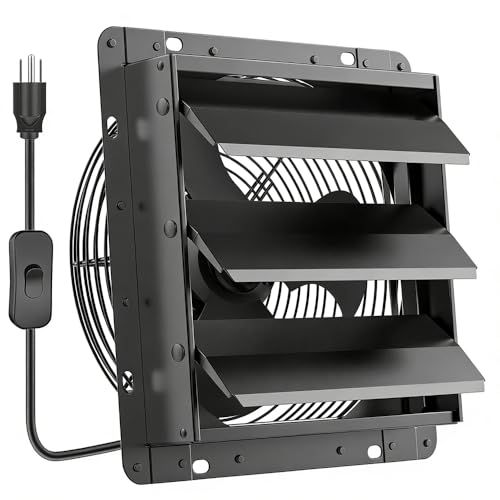
Alternative 1Wall / shutter exhaust

TPI CE 10-DS Shutter-Mounted Exhaust Fan
284 CFM above your per-fan requirement on paper.
Manufacturer ratingAlternative 2Wall / shutter exhaust

TPI CE 12-DS Shutter-Mounted Exhaust Fan
429 CFM above your per-fan requirement on paper. About 2.1× the target; check whether a smaller model or speed setting fits better.
Manufacturer ratingAs an Amazon Associate we earn from qualifying purchases. Matching uses documented airflow and fan style; it does not use commission rates. Affiliate disclosure
What is the correct formula for CFM?
CFM is cubic feet per minute. ACH is the number of room volumes moved in one hour. The calculator converts a target into airflow; it does not choose that target for you. A warehouse with few occupants, a humid process room, and a code-governed commercial space can each need a different design approach.
Required CFM = room volume (ft³) × target ACH ÷ 60
This is the rearranged form of CDC’s equation: ACH = CFM × 60 ÷ room volume. The parentheses matter: divide by the whole room volume, length × width × height. In metric units, required m³/h = volume in m³ × ACH; there is no division by 60 because the flow is already per hour.
Greenheck’s manufacturer sizing tool uses CFM = room volume ÷ minutes per change. Since minutes per change = 60 ÷ ACH, both methods give the same answer. A 4,000 ft³ room at 6 ACH needs 400 CFM; equivalently, 4,000 ÷ 10 minutes = 400 CFM.
Example: a 30 × 40 × 12 ft work area holds 14,400 ft³. A 4 ACH planning scenario equals 960 CFM. For ventilation, that exhaust needs a deliberate makeup-air path; for circulation, the number describes movement within the room, not outdoor air.
For worked imperial and metric examples, see our guide to CFM and air changes per hour.
How to choose an air-change target
There is no universal room-type table that can safely size every application. CDC describes 5 ACH of clean air as a rough guide for reducing infectious particles, not an optimum for all spaces; it also notes that large, lightly occupied spaces may need less and higher-risk spaces may need more. That may be supplied by outdoor air, filtration expressed as equivalent ACH, or a combination, depending on the contaminant.
For occupied commercial and institutional spaces, consult ASHRAE Standard 62.1 and local code. Standard 62.2 covers residential dwelling units; use the standard and edition applicable to your project. These standards set ventilation requirements by space and method; they are not a generic “6 ACH for every room” rule. A licensed mechanical professional should set requirements where compliance, moisture control, pressurization, or occupant exposure is at stake.
Why does a ceiling fan list thousands of CFM?
A ceiling or floor fan moves air within a room to create air speed and improve comfort. An exhaust fan removes air through an opening. Their headline CFM values describe different jobs: a 20,000 CFM ceiling fan does not supply 20,000 CFM of outdoor air, and a 400 CFM ventilation target does not mean a 400 CFM circulation fan will cool the room adequately. Choose a circulation fan using the manufacturer’s coverage and air-speed data, mounting height, layout and operating speed.
How the calculator recommends fans
For ventilation, we show up to three fans in your chosen installation style, ordered by the smallest listed airflow at or above your per-fan requirement. Only active catalog records with a linked manufacturer or listing source for CFM are eligible. Inferred ratings, missing evidence, inconsistent speed ratings, and specialist products outside this room-planning use are excluded. Photos break ties; commissions do not affect the order.
If you choose multiple exhaust fans, the required delivered airflow is shared equally: a 2,000 CFM target with two exhaust outlets means each fan must deliver 1,000 CFM. Each card is an alternative model for those outlets. These are shopping candidates; a catalog rating is not a confirmed installed operating point.
Fans on separate exhaust paths can share a ventilation load when their actual performance and replacement-air supply are accounted for. The Department of Energy’s multiple-fan guidance explains the importance of pressure conditions and fan matching. Do not count supply and exhaust flow twice or add the free-air ratings of fans placed in series in a duct.
For circulation, we match your chosen fan style to the nearest entered CFM rating. This compares products; it does not derive comfort, coverage or the number of cooling fans from ACH. Use manufacturer air-speed and coverage information, mounting clearances, sound levels and controls to make the final choice.
Rated CFM is not necessarily installed CFM
Every elbow, louver, guard, filter, duct run, and discharge condition adds resistance. The operating point is where the fan curve and the system curve meet, so a free-air catalog value is not a substitute for a selection at the required static pressure. Where available, use manufacturer performance data at the expected pressure and verify it after installation.
For industrial selections, favor independently certified data where it applies. AMCA’s Certified Ratings Program covers air-performance ratings, and its fan rating guidance identifies airflow, fan static pressure, and input power as part of a published performance rating.
Ventilation, circulation, and source capture are different jobs
- Ventilation brings outdoor air in, exhausts indoor air out, or both through a balanced path.
- Circulation can improve comfort and mixing, but a floor fan in a closed space adds no outdoor-air exchange.
- Filtration may reduce certain particles and can be expressed as equivalent ACH; it does not automatically remove gases or vapors.
- Local exhaust captures a contaminant near where it is generated. It is the starting point for welding fume, combustible dust, solvent vapor, vehicle exhaust, silica, and similar hazards.
This planner is a first-pass volume calculation. It does not size a hood, dust collector, makeup-air unit, duct, fire/explosion protection, or a system for a hazardous process.
Why one ACH does not mean all air is gone
ACH is a flow-to-volume ratio, not a promise that all original air has been displaced. In the ideal well-mixed, no-source model, one nominal air change leaves about 37% of the original air. Actual rooms can clear more slowly because of stagnant zones and imperfect mixing. The ideal-mixing time benchmarks are mathematical references, never measured clearance times or safety determinations.
How to read the room simulator
The simulator draws your room from above and runs a live airflow model on it. Drag fans, windows and doors anywhere, drag a wall to resize the room, or draw your own outline. The Temperature layer shows how a warm room cools when outdoor air is brought in. Fresh air shows how much of the original air has been replaced at each point. Air movement shows where air moves strongly and where it stalls; the moving streaks follow the modeled flow, sped up where it is slow so you can see it.
Every point cools on its own time scale, set by its modeled local mean age of air: how long, on average, the air at that point has been inside the room. The mixing score divides the nominal air-change time (volume ÷ outdoor airflow) by the room’s mean age of air. About 1 means the room behaves like the textbook well-mixed case. Above 1, outdoor air sweeps across the room. Below 1, part of the incoming air short-circuits to the exhaust and leaves stale pockets.
A floor, drum or pedestal fan on its own moves the same room air around, so it doesn’t change the room’s temperature in the model. It does help mix an exhaust-ventilated room and push air out of stagnant corners. An exhaust fan with no open window, door or intake fan can’t move air at all.
The model is a depth-averaged, two-dimensional incompressible airflow calculation with simplified floor and ceiling friction and an eddy-diffusivity mixing term. Heat gain uses the sensible-heat relation BTU/h = 1.08 × CFM × ΔT. It does not model wind, the stack effect, sun on particular walls, furniture, hot air layering under the roof, humidity, or the pressure losses of ducts and shutters. For engineered building airflow and contaminant analysis, see NIST’s CONTAM software. Our educational simulator is not validated against CONTAM.
FAQ
How do I convert CFM to ACH?
Multiply delivered CFM by 60 and divide by room volume in cubic feet. For example, 500 CFM in a 6,000 ft³ room is 5 ACH.
Should I round up to the next fan size?
Use the calculated CFM as the required operating point, then select a fan that delivers at least that airflow at the system’s expected static pressure. Also evaluate sound, controls, power, mounting, and the available makeup-air route.
Can I use this to size a fan for dust, fumes, or exhaust from engines?
No. Those exposures need task-specific source capture and code-compliant design. Room dilution alone may leave people exposed, and some contaminants introduce fire, explosion, or combustion hazards.
Official sources and assumptions
- CDC/NIOSH, Ventilation FAQs — ACH equation and worked 80 CFM / 1,200 ft³ example.
- Greenheck, Calculate Air Exchange — manufacturer’s equivalent volume / minutes-per-change formula.
- CDC, Appendix B: Air — the ideal-mixing dilution model and its limits.
- CDC, How Much Ventilation Is Enough? — interpretation of 5 ACH of clean air as a rough guide, not a universal target.
- U.S. Department of Energy, Improving Fan System Performance — fan curves, system resistance, and system-level selection.
- AMCA Certified Ratings Program and AMCA Publication 211 — certified fan-performance ratings.
- ASHRAE Standards 62.1 and 62.2 — recognized ventilation and indoor-air-quality standards.
The CFM calculation uses your room volume and chosen ACH target. The ideal-mixing reference assumes constant stated airflow and instantaneous mixing. The room simulator uses the simplified assumptions described above. Neither determines actual installed flow, temperature, filter efficiency, leakage, or the effect of a continuing contaminant source.